
Why isn't our digital delivering?
Key takeaways
- Ads, content, social, email and digital PR all send people to one place: your website. If the site isn't working, every channel underperforms.
- A four-layer website audit checks Brand, Experience, Conversion and Visibility. The layers are connected, so a gap in one shows up in the others.
- Contentsquare found only 1.7% of new visitors convert, against 2.9% of returning visitors. Most people need an easier next step, or a reason to come back.
- Then prioritise: know who visits, find where their journey breaks, make the smallest high-impact changes first, and measure what improves.
When digital marketing isn't delivering, the cause is usually the website, not the channels sending people to it. A four-layer website audit checks whether your site says who you are, works smoothly, turns visits into enquiries and can be found. Then you fix the highest-impact gaps first.
"Why isn't our digital delivering?" is the question I hear most, though rarely in those words. Usually it's "why aren't leads coming through?" or "we're spending on ads, but nothing converts." I've heard versions of it from international schools, a fintech platform, beauty ecommerce brands and cafes. The answer almost always starts in the same place.
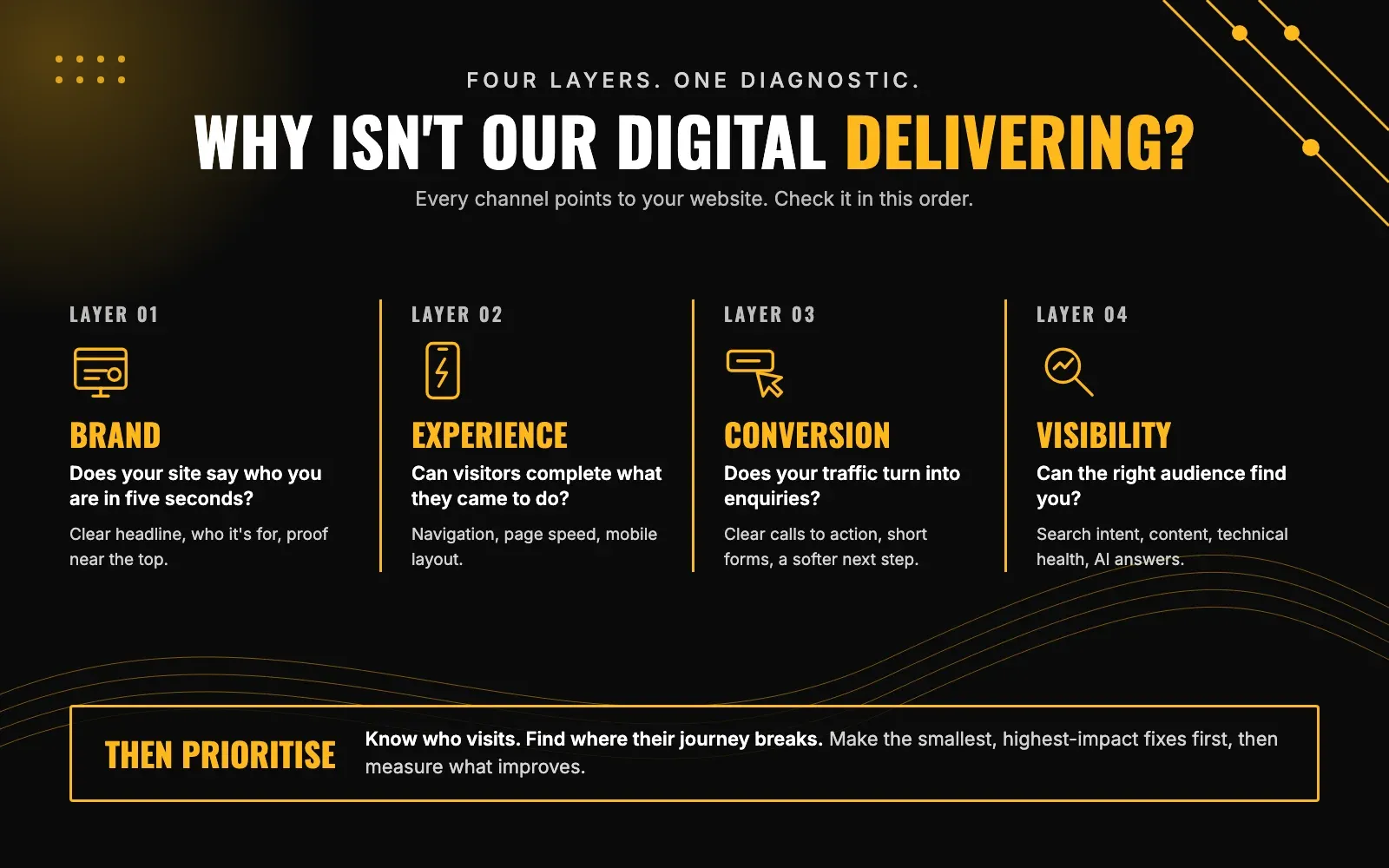
Why does every digital channel come back to your website?
Ads, content, social, email and digital PR all point to one destination. If that destination isn't working, nothing upstream can fix it. Spending more on ads just sends more people to the same leak.
It also matters more than it did a few years ago. Contentsquare's 2026 benchmark found 59% of sites saw traffic fall in 2025, while the cost of each visit has risen 30% over three years. In search, Ahrefs found that when an AI Overview (the AI-written summary at the top of some Google results) appears, the top-ranking page gets 58% fewer clicks on average.
Each visit is harder to earn and costs more. So your website has to do more with every one. That's why I start with the site, before touching a campaign.
What does a four-layer website audit check?
Every website I audit goes through the same four layers, then a prioritisation step. The layers are connected. A confusing brand message hurts conversion. A slow mobile page hurts visibility as well as experience.
| Layer | The question | What I look at | A common sign it's broken |
|---|---|---|---|
| 1. Brand | Does your site say who you are in five seconds? | Headline, value proposition, proof, visual consistency | Visitors leave the home page or ask questions the site should answer |
| 2. Experience | Can visitors complete what they came to do? | Navigation, page speed, mobile layout, errors | Rage clicks, slow mobile pages, drop-offs mid-journey |
| 3. Conversion | Does your traffic turn into enquiries? | Calls to action, forms, softer next steps, tracking | Traffic goes up, enquiries stay flat |
| 4. Visibility | Can the right audience find you? | Search intent, content, technical health, AI answers | Few searches beyond your brand name, pages not indexed |
| Then: Prioritise | What do you fix first? | Customer needs, journey breaks, impact against effort | A long list of fixes and no order |
Layer 1, Brand: does your site say who you are in five seconds?
Visitors decide fast. Within the first screen, they should know what you do, who it's for and why they should choose you. If the first impression is confusion, nothing downstream matters.
The brand gap I see most often isn't poor design. It's a site written for insiders. Pages describe the organisation's structure, programmes or technology before they answer what the customer came to find out.
What I check:
- Is the headline about the customer's outcome, or about your company?
- Is there proof near the top, such as reviews, client names or accreditations?
- Does the site look and sound like the business people met in an ad or on social media?
A simple test: show your home page to someone outside the business for five seconds. Then ask what you do and who it's for. If the answer is vague, the fix is often brand and website work before any more ad spend.
Layer 2, Experience: can visitors complete what they came to do?
Every visitor arrives with a job. Check a menu. Compare fees. Book a tour. Request a demo. Experience is whether they can finish that job without friction. Every friction point is a lost enquiry.
Friction is still common. Contentsquare found it affects 35.2% of sessions, and slow page loads affect 10.9%. Google recommends site owners "achieve good Core Web Vitals for success with Search". These are Google's measures of loading speed, responsiveness and visual stability.
What I check:
- The top three customer journeys, walked on a phone the way a customer would.
- Session recordings in a free tool like Microsoft Clarity, looking for rage clicks (repeated taps on something that doesn't respond) and dead ends.
- Page speed on mobile, not just on the office wifi.
For a cafe, the job is usually reading the menu or booking a table. For a school, it's often finding fees or booking a campus tour. When those journeys need more than a few tweaks, a rebuild may be the better investment. I cover what that involves for web design in Singapore and for websites built for Melbourne businesses.
Layer 3, Conversion: why is my website getting traffic but no enquiries?
Usually because the next step is too big, too hidden or not being tracked. Contentsquare found only 1.7% of new visitors convert, compared with 2.9% of returning visitors. Most people aren't ready to commit on a first visit. The rest need an easier next step, or a reason to come back.
What I check:
- One clear call to action per page. The call to action is the button or link that asks for the next step.
- Short forms. Ask only for what you need to respond.
- A softer step for people who aren't ready. A guide, a price range, a newsletter or a tour booking keeps them in touch.
- Answers to the questions that stall decisions. Pricing, timelines, eligibility and what happens after someone enquires.
- Tracking that counts real enquiries. If you can't measure enquiries accurately, you can't tell which pages work.
On one fintech platform, the lead tracking counted job applications alongside customer enquiries. Separating the two gave a true lead count to judge the site against. If your ad platforms are learning from data like that, your conversion signals may be the real problem, not your ads.
Layer 4, Visibility: can the right audience find you?
The best-looking website means nothing if nobody sees it. Visibility covers four things: search intent (whether your pages match what people actually type), content alignment, technical health (whether Google can crawl and index your pages) and AI answers such as Google's AI Overviews.
AI search hasn't replaced the basics. Google says there are no extra requirements or special optimisations needed to appear in AI Overviews or AI Mode. A page must be indexed and eligible to show a snippet in Google Search. I go deeper on this in the SEO fundamentals AI can't skip for you.
When the fundamentals are in place, results can follow in both search and AI answers. One international school in Singapore earned 304 citations in AI answers across Google AI Overviews, AI Mode, ChatGPT, Perplexity and Gemini. After a fintech platform's new website launched, its non-brand search clicks grew 245% in 10 months. Non-brand means searches that don't include the company's name: new people finding you.
No one can guarantee rankings or AI citations. But both results started with the same visibility checks. If AI answers matter for your category, here's how I approach AI search optimisation.
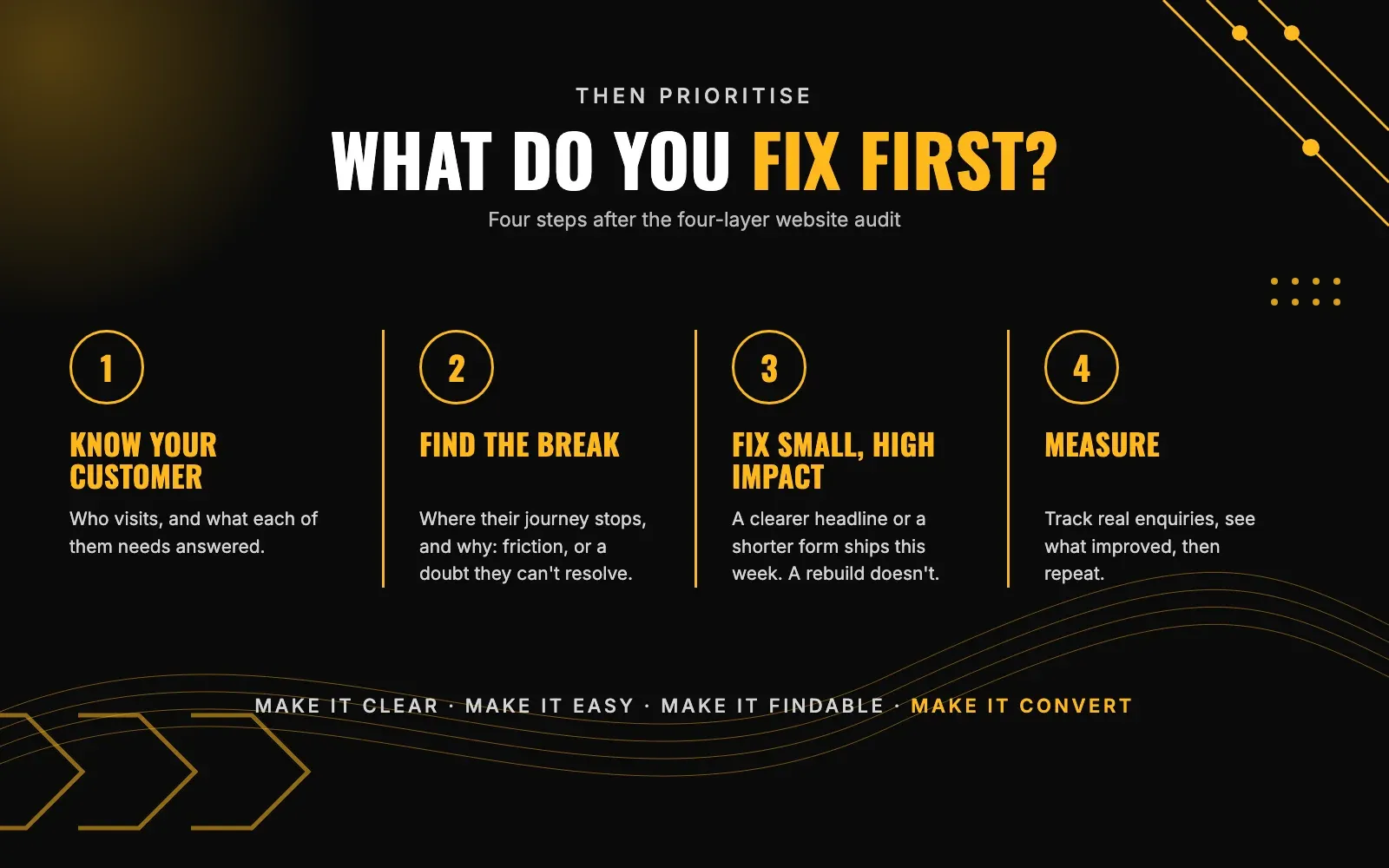
Then prioritise: what should you fix first?
An audit that hands you 200 issues with no order isn't much help. Prioritising is where an audit earns its fee.
- Know your customer. Who visits, and what does each of them need answered? A prospective parent and a corporate events buyer want different things from the same site.
- Find where their journey breaks, and why. Sometimes it's friction, like a form asking for too much too soon. Often it's something they can't verify, like an unanswered question or pricing three clicks deep.
- Make the smallest, highest-impact changes first. A clearer headline or a shorter form can go live this week. A rebuild can't.
- Measure what improves. Then repeat.
So when digital isn't delivering, don't start by changing the ads. Start with the website. I've seen it hold true in education, ecommerce, hospitality and fintech.
How is this different from an SEO audit or a redesign?
An SEO audit focuses mainly on the Visibility layer: crawling, indexing, structured data, page speed and keyword targeting. A redesign changes how the site looks and works, but it doesn't always start from evidence about what's broken.
A four-layer review comes before both. It tells you whether your problem is brand, experience, conversion or visibility, so you spend on the right fix. If the answer is mostly visibility, a fixed-price technical audit with a priority list is the logical next step.
Frequently asked questions
What should a website audit include?
A useful website audit covers four layers: Brand (is the message clear), Experience (can visitors complete their task), Conversion (does traffic become enquiries) and Visibility (can the right people find you). It should end with a priority list, not just a list of issues.
How often should you audit your website?
I suggest a full review once a year. Also run one before a redesign, a site migration or a big increase in ad spend, and whenever enquiries drop without an obvious reason.
Can I audit my own website for free?
Partly. Google's PageSpeed Insights and Search Console are free and cover speed and indexing. Microsoft Clarity is free for session recordings. Brand and conversion are harder to judge from inside the business, so a fresh pair of eyes helps there.
Can ChatGPT or other AI tools do a website audit?
AI tools can speed up crawling, summarising and spotting patterns, and I use them for exactly that. They can't tell you what your customers need answered, or which fix matters most for your business. A person should check every recommendation before you act on it.
Why is my website getting traffic but no enquiries?
Usually the next step is too big, too hidden or not tracked properly. Check that each page has one clear call to action, that forms are short, and that people who aren't ready yet have a softer option. Then confirm your tracking counts genuine enquiries.
Not sure which layer is holding you back? Start with an audit and a clear priority list, or book a call to talk it through.
Sources
- Contentsquare: 2026 Digital Experience Benchmark - Conversions
- Contentsquare: 2026 Digital Experience Benchmark - Traffic
- Contentsquare: 2026 Digital Experience Benchmark - Frustration
- Ahrefs: Update: AI Overviews Reduce Clicks by 58%, Feb 2026
- Google Search Central: Core Web Vitals
- Google Search Central: AI features and your website
- Own data (anonymised): Ahrefs, Sep 2026 (international school AI citations); Google Search Console, Nov 2025 vs Sep 2026 (fintech platform non-brand clicks).