Your ads aren't underperforming. Your conversion signals are.
Key takeaways
- Google and Meta use AI to decide who sees your ads. That AI learns from the conversions your tracking reports back.
- If tracking counts the wrong action, misses sales or double-counts them, the platform optimises toward the wrong people.
- Google says enhanced conversions lift Search conversions by 11% on average. Meta says advertisers using its Conversions API saw 17.8% lower cost per result.
- Check tracking before you change creative, budgets or agencies. It is the cheapest fix in the account.
If your ads are getting clicks but not enough enquiries or sales, check your conversion tracking before you blame the creative. Google and Meta optimise toward whatever your tracking reports as a conversion. When those signals are missing, duplicated or measuring the wrong action, the platform spends your budget finding more of the wrong people.
I see this pattern again and again when I audit paid accounts. The ads look fine. The targeting looks fine. The measurement underneath is broken.
Contents: Why ads underperform | How the algorithm uses conversions | Where signals get lost | Server-side tracking | How to check yours | What I see in audits | FAQs
Why do ads underperform when the creative is fine?
Because the ad platform is optimising on bad information. Creative and budget only work when the system choosing your audience knows which clicks turned into customers.
Paid media now carries more of the load, and it costs more. Contentsquare's 2026 Digital Experience Benchmark found that 42% of all website traffic comes from paid channels, and that the cost of a visit rose 9% year on year, up 30% over three years. When almost half your visitors are paid for, and each one costs more, a measurement gap is expensive.
The usual response is to change something visible: new ads, a bigger budget or a new agency. That rarely helps while the account is learning from the wrong signals, which is why I start every review of paid advertising with the tracking.
What is conversion tracking, and why does the algorithm depend on it?
Conversion tracking records when someone who saw or clicked your ad does something valuable, such as buying, booking or sending an enquiry. That record is sent back to the ad platform as a "conversion signal".
Most campaigns now use automated bidding, where the platform's AI decides what to bid and who sees the ad. Google's Smart Bidding and Meta's ad delivery both learn from your conversion signals. Every conversion tells the system, "find more people like this one."
Google is direct about the risk. Its help page says getting primary and secondary conversion actions right "is critical", because misconfiguring them "can prevent Smart Bidding from optimizing effectively, as the algorithm relies on these signals". Meta's documentation describes its Conversions API as the link between your data and the "Meta systems that optimize ad targeting, decrease cost per result and measure outcomes".
So the algorithm is only as good as what you feed it. Whether you work with a Google Ads consultant or run Facebook and Instagram ads in-house, the first question is the same: what is the account actually counting?
Where do conversion signals get lost?
In my audits, signal problems fall into five groups. Many accounts have more than one.
- Counting the wrong action. The account treats a page view, a button click or an empty form submission as a conversion. The platform then hunts for people who click buttons, not people who buy.
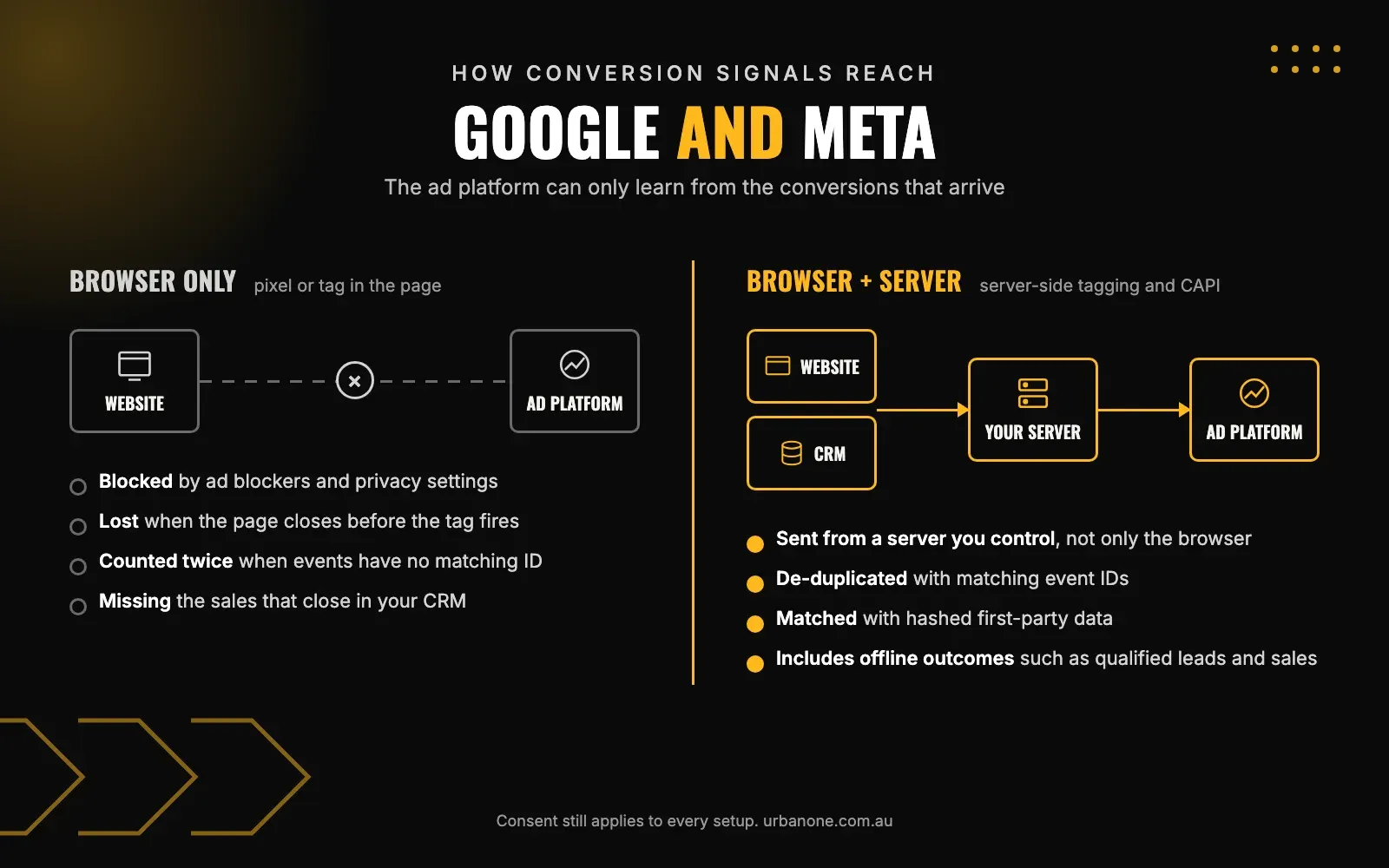
- Browser-only tracking. A pixel or tag that runs only in the visitor's browser can be blocked by ad blockers, privacy settings or a page that closes before the tag fires. Those conversions never reach the platform.
- Duplicates. The same sale is recorded twice, for example by the Pixel and a server event without matching IDs, or by a thank-you page that reloads. Results look better than they are, and bidding chases inflated numbers.
- Offline sales that never come back. For lead generation, the real outcome (a signed contract, an enrolment, a booking that turned up) happens in a CRM or over the phone. If it is never sent back, the platform only learns who filled in a form.
- Poor matching. Meta's documentation states that "only matched events" are used for attribution and ad delivery. Events sent without enough customer information may not be matched to a person, so they don't help the algorithm learn.
Does server-side tracking fix it?
It fixes the browser problem, and it is the right base for the other fixes. It does not fix a badly chosen conversion action. You still need to decide what counts.
Standard tags run in the visitor's browser. With server-side tagging, a server container sits in between. Google explains that this container "doesn't run in the user's browser or on their phone. Instead, it runs on a server that you control", and that "only you have access to the data in the server until you choose to send it elsewhere".
Each platform also has its own way to send stronger signals:
| Method | Platform | What it does | Platform-reported result |
|---|---|---|---|
| Conversions API | Meta | Sends events from your server or CRM, alongside the Pixel | 17.8% lower average cost per result for advertisers with a web Conversions API setup Meta, Apr 2026 |
| Enhanced conversions | Adds hashed (scrambled) first-party data, such as email, to conversions so Google can match them | 11% average increase in Search conversions vs standard conversion imports Google, Sep 2026 |
|
| Google tag gateway | Serves Google tags through your own website infrastructure | 14% average conversion uplift Google, Sep 2026 |
|
| Enhanced conversions for leads | Matches offline outcomes from your CRM back to the ad click | Google recommends it over classic offline import for new setups Google Ads Help |
These are averages the platforms report about their own tools, not a promise for your account. But both now openly link better data to better results.
Two rules make this work. First, Meta's documentation recommends running the Conversions API "alongside" the Pixel, with matching event IDs so each sale is counted once. Second, the server is not a way around privacy law. Consent still applies.
I set up server-side tracking and the Meta Conversions API for Cognita's international schools across Asia, along with first-time channel attribution, so each enquiry could be traced to the channel where the family first found the school. The work that took longest was not the server. It was agreeing what counted as a real enquiry.
How do I check whether my conversion tracking is working?
Compare what the ad platforms report with what actually arrived in your CRM or till. If the numbers don't roughly agree, the platforms are learning from the wrong data.
You can run a basic check yourself:
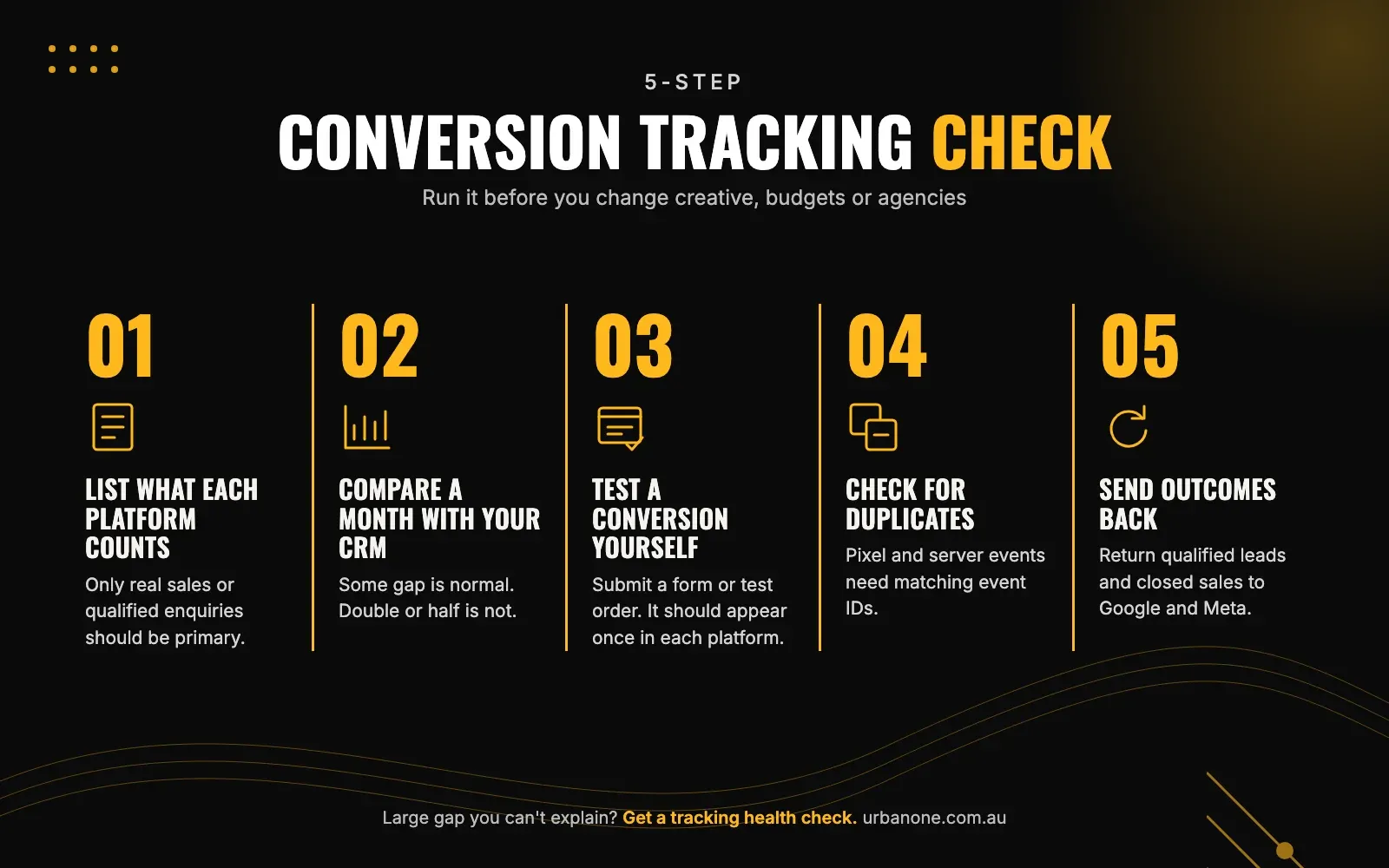
- List what each platform counts. Note which Google Ads conversion actions are primary, and which event each Meta campaign optimises for. Anything that isn't a real sale or qualified enquiry should not be primary.
- Compare one month of numbers. Put Google Ads, Meta, GA4 and your CRM side by side for the same month. Some gap is normal, because each platform credits sales differently. A gap of double or half is not.
- Test a conversion yourself. Submit your own form or make a test purchase, then confirm it appears once, not twice, in each platform.
- Check for duplicates. If you run the Pixel and the Conversions API, confirm Events Manager shows events as de-duplicated.
- Check what happens after the form. Ask whether qualified leads or closed sales are ever sent back to Google or Meta. If not, the platforms only know who filled in a form.
If step 2 shows a large gap and you can't explain it, that is when a Google Ads account review or tracking audit pays for itself.
What do I see when I audit paid accounts?
The same few problems, across very different sectors.
On a fintech platform's website, the lead reports were counting job applications from the careers pages as enquiries. One contact form served both. Nobody had noticed, because the totals looked healthy. I split the two in 2026, so the reports now show genuine enquiries only. Had that data been feeding an ad platform, it would have been optimising for job seekers.
At an international school in Singapore, the hard part was the months between an enquiry and an enrolment. The form fill is easy to track. Whether the family enrolled lives in the admissions system, and has to be connected back deliberately.
Earlier, I spent seven years running digital marketing and ecommerce for a group of beauty and F&B brands. Across brands with similar creative and budgets, the ones with sound conversion tracking got more from the same spend.
Tracking is also only one layer of the problem. If enquiries are low even when tracking is right, the cause may be the brand, the website experience or search visibility. My four-layer website audit covers how to find which one.
FAQs
Which conversions should I track for lead generation?
Track the actions closest to revenue as primary conversions: qualified enquiries, booked calls or sales. Keep softer actions, such as brochure downloads or page visits, as secondary so you can see them without the bidding system chasing them. Google calls getting this split right "critical" for Smart Bidding.
Why do Google Ads, Meta and GA4 show different conversion numbers?
Each platform uses its own attribution rules, so some difference is normal. Large gaps usually point to missing tags, duplicates or different definitions of a conversion. Use your CRM as the reference point.
Do I need a developer to set up the Meta Conversions API?
Not always. Meta now offers a one-click Conversions API setup for website events in Events Manager, with "no code, configuration, or setup fees". Server-side tagging across several platforms, or sending CRM outcomes back, usually needs technical setup.
Does server-side tracking get around privacy rules?
No. In Singapore, the PDPA requires consent before personal data is collected, used or disclosed for a purpose (PDPC). In Australia, the OAIC lists IP addresses among the kinds of information that can be personal information. Server-side tracking gives you more control over what is sent, but consent and privacy notices still apply. This is not legal advice.
How long before better tracking improves results?
It varies. Ad platforms need time and volume to relearn after conversion settings change, and accounts with few conversions take longer. I'd judge the change over a few months, not days, and compare against your CRM rather than the platform's own figures.
Should I fix tracking before changing my ads or agency?
Yes. If the measurement is wrong, you can't tell whether new creative or a new agency is working. Fixing the signals first gives every later change a fair test.
Fix the signals, then judge the ads
If your ads feel like they've stopped working, start with what they're learning from. A tracking health check shows what each platform is counting, where signals are lost and what to fix first.
Sources
- Contentsquare: 2026 Digital Experience Benchmark, "From volume to value: the new rules of digital traffic"
- Google Ads Help: About conversion measurement
- Meta for Developers: Conversions API
- Meta for Developers: Conversions API best practices
- Meta for Developers: Handling duplicate Pixel and Conversions API events
- Meta for Business: Removing Technical Barriers to Help Businesses of All Sizes Get More From Their Ads, 15 April 2026
- Google: Drive profitable growth with new data and measurement tools, 10 September 2026
- Google Tag Platform: Introduction to server-side tagging
- Google Ads Help: About offline conversion imports
- PDPC: Advisory Guidelines on Key Concepts in the PDPA
- OAIC: What is personal information?