
The SEO fundamentals AI can't skip for you
AI can now draft pages, write meta tags and produce reports in minutes. What it can't do is decide which pages should exist, who they're for, or how they fit together. The SEO fundamentals are the same five they've always been: a site search engines can read, content that matches intent, clear structure, reliable measurement and steady effort. AI makes each one faster. It doesn't make any of them optional.
Key takeaways
- More AI content doesn't mean more traffic. Without a plan, it often means more pages competing with each other.
- Five fundamentals still decide results: technical foundations, intent-matched content, site architecture, measurement and consistency.
- Google says optimising for its AI search features is still SEO. No special files or markup are needed.
- AI is best used to speed up the work you already know is right, not to choose the work.
- Judge SEO by enquiries and sales, not by how many pages you publish.
Why isn't more AI content bringing more traffic?
Because volume was never the bottleneck. I keep seeing the same pattern in the sites I audit: content output triples with AI tools, and traffic doesn't move. Neither does visibility in AI answers.
Everyone downloaded the same prompt packs and connected the same tools. So everyone can now produce the same pages, at the same speed.
A prompt generates a page. It doesn't tell you whether that page should exist at all. It can't tell you whether it serves the right intent, competes with a page you already have, fits a structure that builds authority, or can even be read by search engines.
Google is direct about this. Its spam policies define scaled content abuse as "many pages" created "for the primary purpose of manipulating search rankings and not helping users", and say this applies "no matter how it's created". The tool isn't the problem. Publishing without a reason is.
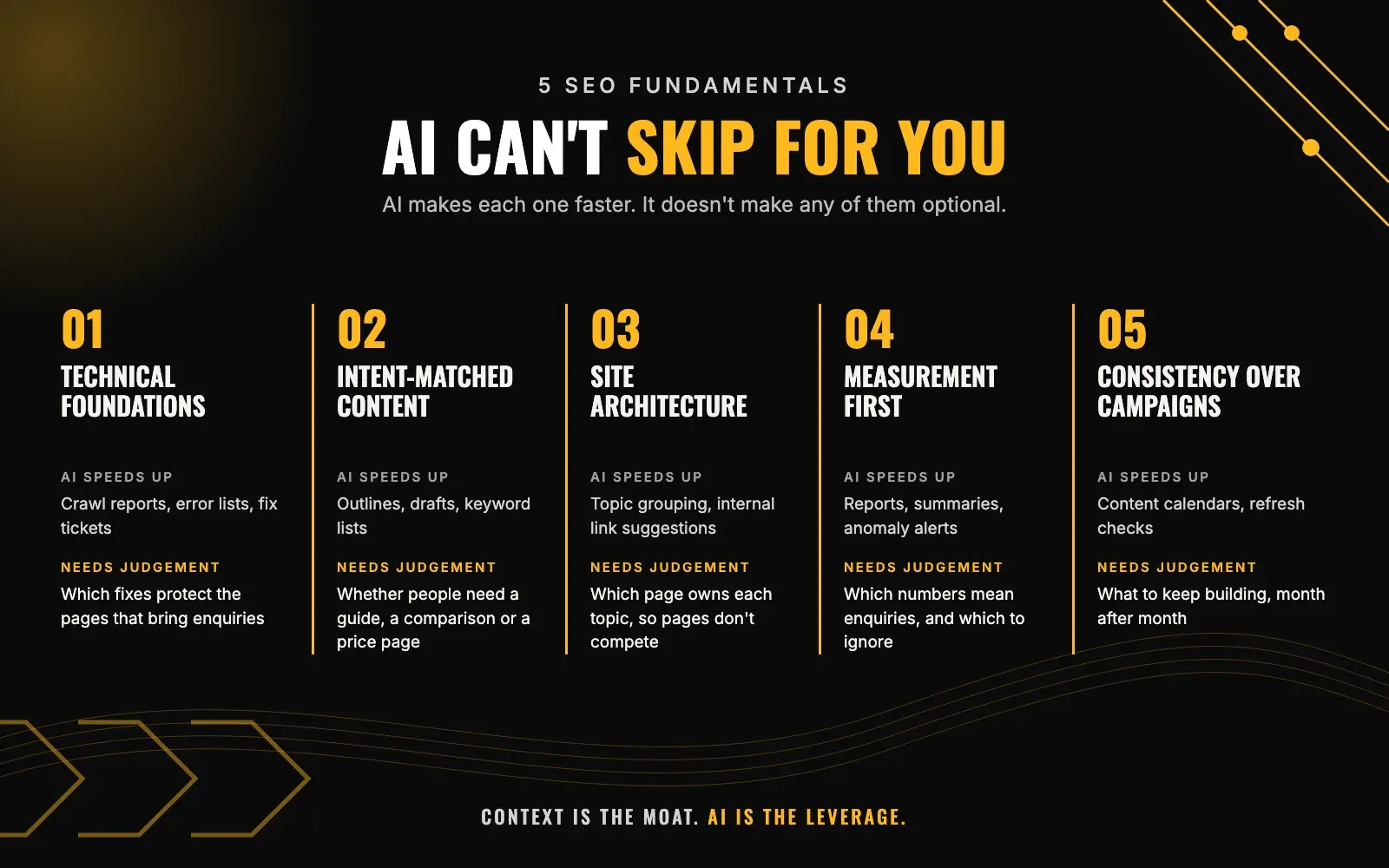
What are the five SEO fundamentals AI can't skip?
I apply these five in every engagement, for schools, fintech platforms, online stores and cafes.
- Technical foundations. If search engines can't read it, nothing else matters.
- Intent-matched content. Write for the question, not the keyword.
- Site architecture. Structure is strategy.
- Measurement before optimisation. You can't improve what you're not tracking.
- Consistency over campaigns. SEO compounds. Campaigns stop when the budget does.
1. Can search engines and AI tools actually read your site?
Everything else depends on this. Technical SEO covers whether search engines can find, crawl (read) and index (store) your pages, and whether those pages load quickly on a phone.
Google's own guidance for AI Overviews and AI Mode makes the link clear. To appear as a supporting link, "a page must be indexed and eligible to be shown in Google Search with a snippet". If a page isn't indexed, it can't appear in AI answers on Google either.
The problems I find are usually quiet: a template that blocks key pages, a redesign that broke old links, or important pages that only load after a script runs. Technical debt is invisible. Lost rankings aren't.
AI tools can sort crawl reports, group errors and draft fix tickets in minutes. But they don't know which fixes protect the pages that bring you enquiries. That ordering is the job. If you're not sure where your site stands, start with a full check of your site's technical health before you publish anything new.
2. Does each page answer the question behind the search?
Search intent is what the person searching actually wants. Someone typing "international school fees" wants numbers and a comparison. Someone typing "how to choose a school" wants a guide. Same topic, different page.
AI can produce any format you ask for. The hard part is knowing which format your audience needs at that moment: a how-to, a comparison or a page that helps them decide. That knowledge comes from the sector, not the tool. AI writes for keywords. Experience writes for the person behind the search.
Google frames it the same way. Google says its ranking systems "prioritize helpful, reliable information that's created to benefit people". Its own self-check asks whether you're "producing lots of content on many different topics in hopes that some of it might perform well".
A quick test I use with clients: read the top three results for your target search. If they're all comparison pages and yours is a sales page, you're answering a different question.
3. How should your site be structured for SEO?
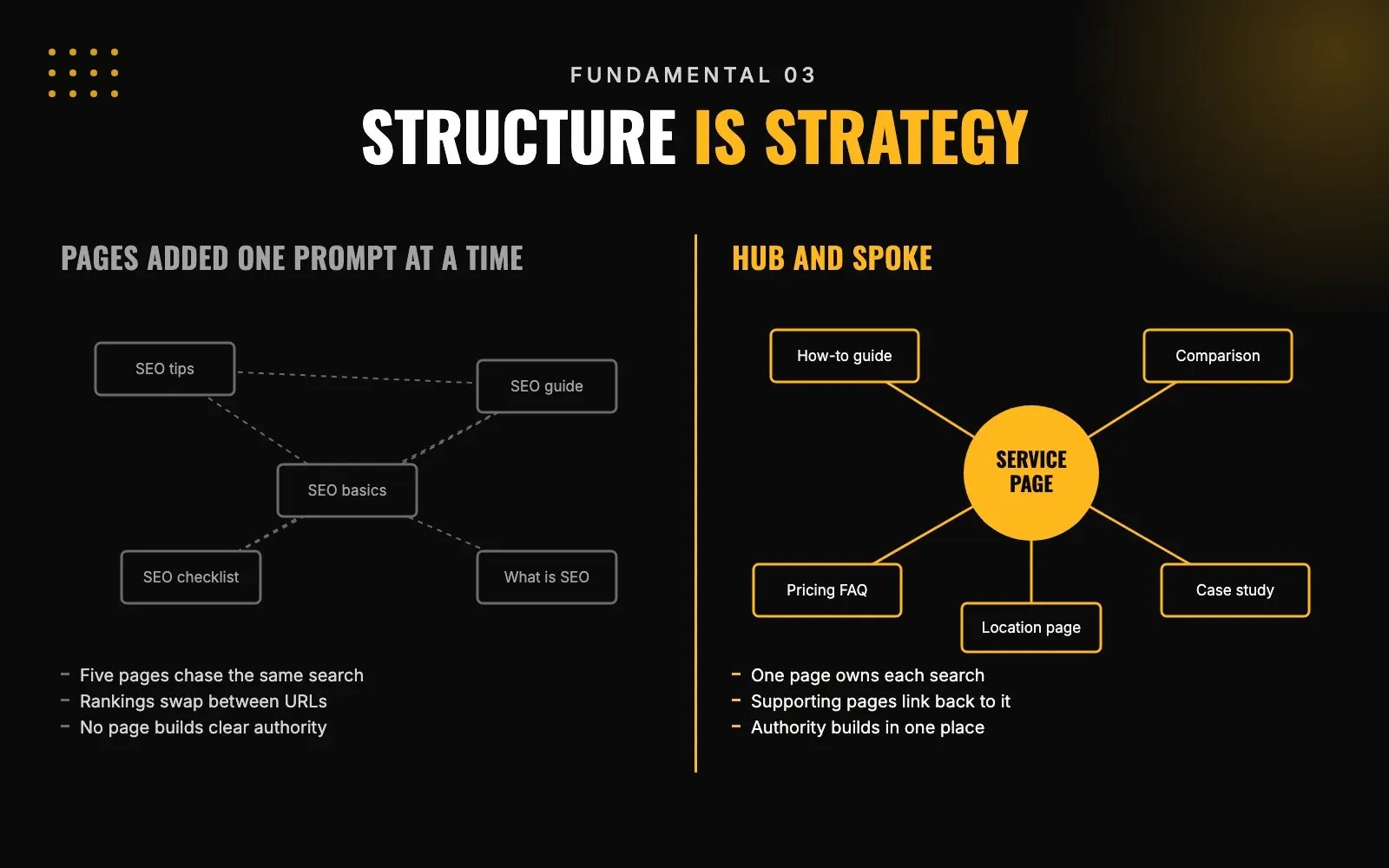
Structure decides which page wins. When pages are added one prompt at a time, you often end up with five pages chasing the same search. Rankings swap between them, and none builds clear authority. This is called keyword cannibalisation.
The fix is a hub-and-spoke structure. One main page owns each topic. Supporting pages (guides, comparisons, FAQs and case studies) answer the related questions and link back to it.
I've applied the same principle to multi-brand ecommerce sites and international school networks. The logic doesn't change: decide what each page is for, and which page owns each topic, before you write it. That depends on what you sell, which no tool knows better than you.
4. How do you know which SEO work is paying off?
You can't improve what you're not tracking. I've audited sites where zero conversion events were configured. The client was reporting traffic and rankings, with no way to see which pages brought enquiries.
Measurement comes before optimisation. At a minimum, that means:
- Google Search Console connected and checked monthly
- Enquiry forms, calls and bookings tracked as key events in GA4
- Real enquiries separated from noise, such as job applications or spam
Google Search Console already includes AI Overviews and AI Mode traffic. Google's same guidance says it's reported "in the Performance report, within the 'Web' search type". You don't need a separate tool to start.
Knowing what to measure, and what to ignore, comes from experience. If your ad platforms and analytics disagree about what counts as a conversion, the problem usually isn't the ads. I cover that in why your ads aren't underperforming, but your conversion signals are.
5. Why does SEO compound when campaigns don't?
SEO is a compounding asset, not a campaign. Paid ads work like rent: the traffic stops when you stop paying. Good SEO work keeps paying back, because pages that rank and get cited keep earning visits.
It also takes patience. Google's own starter guide says some changes "might take effect in a few hours, others could take several months".
A fintech platform I work with grew non-brand search clicks by 245% in 10 months. Non-brand means searches that don't include the company's name, so these are new people finding the business. That came from steady work on the fundamentals, not a single push.
In another case, an international school in Singapore earned 304 citations in AI answers across Google AI Overviews, AI Mode, ChatGPT, Perplexity and Gemini. None of those came from special AI files. Nobody can guarantee AI citations, but both cases came from the same place: pages search engines could read, that answered real questions, inside a clear structure.
Where does AI actually help with SEO?
AI is the leverage. Here's where I use it, and where a person still has to decide.
| Fundamental | What AI speeds up | What still needs judgement |
|---|---|---|
| Technical foundations | Crawl reports, error grouping, fix tickets | Which fixes protect the pages that bring enquiries |
| Intent-matched content | Outlines, first drafts, keyword lists | Whether people need a guide, a comparison or a price page |
| Site architecture | Topic grouping, internal link suggestions | Which page owns each topic |
| Measurement | Reports, summaries, anomaly alerts | Which numbers mean enquiries, and which to ignore |
| Consistency | Content calendars, refresh checks | What to keep building, and what to stop |
Google's guidance on AI-generated content is clear on the last step: "It is critical to manually factcheck and review all AI-generated content for accuracy and trustworthiness before publishing". Every page I publish with AI help gets that check.
Is SEO still worth it with AI Overviews?
Yes, but the payoff has changed shape. Ahrefs found in February 2026 that when an AI Overview appears, the top-ranking page sees a 58% lower average click-through rate. Ranking first no longer guarantees the clicks it used to.
At the same time, AI is starting to send traffic of its own. Contentsquare's 2026 benchmarks show AI-referred traffic grew 632% year on year, but it still makes up just 0.2% of all traffic. Small, but growing fast.
Your pages now need to be the ones search engines rank and AI tools quote. Google says that work "is optimizing for the search experience, and thus still SEO". The fundamentals cover both. You can read more about how I approach visibility in AI answers.
If your site has the fundamentals but still isn't bringing enquiries, the issue may sit outside search. I walk through brand, experience and conversion in why isn't our digital delivering?
Frequently asked questions
Can AI do SEO for me?
AI can do many SEO tasks: drafting content, writing meta descriptions, sorting crawl data and building reports. It can't decide which pages your site needs, which page should own each topic, or which results matter to your business. Use it to speed up a plan, not to replace one.
Is SEO dead because of AI?
No. Google says optimising for its AI features is still SEO, and pages must be indexed to appear as links in AI Overviews and AI Mode. What has changed is that ranking first brings fewer clicks when an AI Overview appears, so being quoted in AI answers matters more.
Do I need an llms.txt file or special markup for AI search?
Not for Google. Google says there are no extra requirements to appear in AI Overviews or AI Mode, and no special files, markup or schema are needed. It also says keeping an llms.txt file for other services is fine.
What are the fundamentals of technical SEO?
Search engines must be able to crawl your pages, index them and show them with a snippet. Pages should load quickly and work well on mobile, and old URLs should redirect properly after a redesign. Google recommends good Core Web Vitals, its measures of loading, responsiveness and visual stability.
Is AI-generated content bad for SEO?
Not by itself. Google's spam policies target content made mainly to manipulate rankings, however it's produced. AI-assisted content is fine when it's fact-checked, reviewed and genuinely useful to the reader.
How long does SEO take to work?
Google says some changes can take effect within hours, while others take several months. In general, wait a few weeks before judging whether a change helped. Building authority across a whole site takes longer.
Get the fundamentals right first
Every engagement I take on starts with the same question: which of these five is holding your site back? For businesses in Singapore and Melbourne, I start with an audit and a clear priority list, so you know what to fix first and why. See the full range of SEO services.
Sources
- Google Search Central: Spam policies for Google web search (scaled content abuse)
- Google Search Central: AI features and your website
- Google Search Central: Creating helpful, reliable, people-first content
- Google Search Central: SEO Starter Guide
- Google Search Central: Using generative AI content
- Google Search Central: Optimizing for AI search guide
- Google Search Central: Core Web Vitals
- Ahrefs: Update: AI Overviews Reduce Clicks by 58%, 4 Feb 2026
- Contentsquare: 2026 Digital Experience Benchmarks: traffic
- Own data (anonymised): Google Search Console, Nov 2025 vs Sep 2026 (fintech platform non-brand clicks); Ahrefs, Sep 2026 (international school AI citations).